

Boardroom
Share trusted financial performance with every decision-maker
Boardroom is the Finance-native reporting and visualization layer of the Nocloz platform.
It turns governed financial data into dashboards, reports, and performance views that executives, investors, managers, and operational teams can understand, explore, and trust.
Finance shares the right numbers, at the right level of detail, with the right people — while keeping full control over definitions, access rights, salary visibility, and depth of exploration.
Turn trusted financial data into controlled, decision-ready reporting.
Financial reporting built for the way Finance works
Finance teams need reporting experiences that respect financial structures, management definitions, monthly closing cycles, access rights, published numbers, budget comparisons, salary confidentiality, EBITDA normalizations, and entity-level complexity.
Boardroom is built for that work. It connects directly to the trusted financial data prepared in Builder and gives Finance a dedicated space to create, configure, publish, and share financial views across the company.
Every dashboard is built on the same governed data foundation: actuals, budgets, payroll, adjustments, reclassifications, normalized EBITDA, exceptional items, and management reporting rules.


From governed data to decision-ready reporting
Boardroom helps Finance turn prepared financial data into interactive reporting experiences that match how the company manages performance.
Finance can create dashboards for P&L, balance sheet, cash flow, budget vs actuals, margin, EBITDA, payroll, departments, entities, business units, projects, and custom financial views.
Reports can be structured by rows, columns, filters, periods, entities, partners, departments, employees, projects, sites, or management levels — and explored from group-level reporting down to the level Finance allows.
How Boardroom works
Every financial report starts with a question. Every question deserves a clear, trusted, and controlled answer.
Boardroom gives Finance the tools to build reporting views that reflect how the business is actually managed, share them with the right people at the right level of detail, and keep full control over what gets published and who can explore it.
What gets shared from Boardroom is what executives see, what managers act on, and what investors rely on.
1.
Build Finance-native dashboards and reports
Boardroom lets Finance create reporting views that reflect financial meaning: P&L, balance sheet, cash flow, budget vs actuals, EBITDA, margin, payroll, entity performance, department-level P&L, investor reporting, and custom management views.
Reports can be structured around accounts, management levels, periods, entities, departments, partners, projects, employees, actuals, budgets, adjustments, and normalized views.
2.
Share the right view with the right audience
Boardroom tailors financial visibility by role, scope, and sensitivity.
A CEO can access the full group view. A department leader sees their own perimeter. A manager explores the level of detail Finance has approved. An investor accesses a board-level reporting pack. A Finance user analyzes deeper layers of the same data.
3.
Control access rights and depth of exploration
Finance manages access by board, report, entity, metric, data scope, salary visibility, and drill-down depth.
The same report can display salary details for authorized users and a salary-free version for others. One user may access a high-level P&L; another may drill down to department, partner, employee, project, or transaction-level detail.
4.
Publish validated numbers to the business
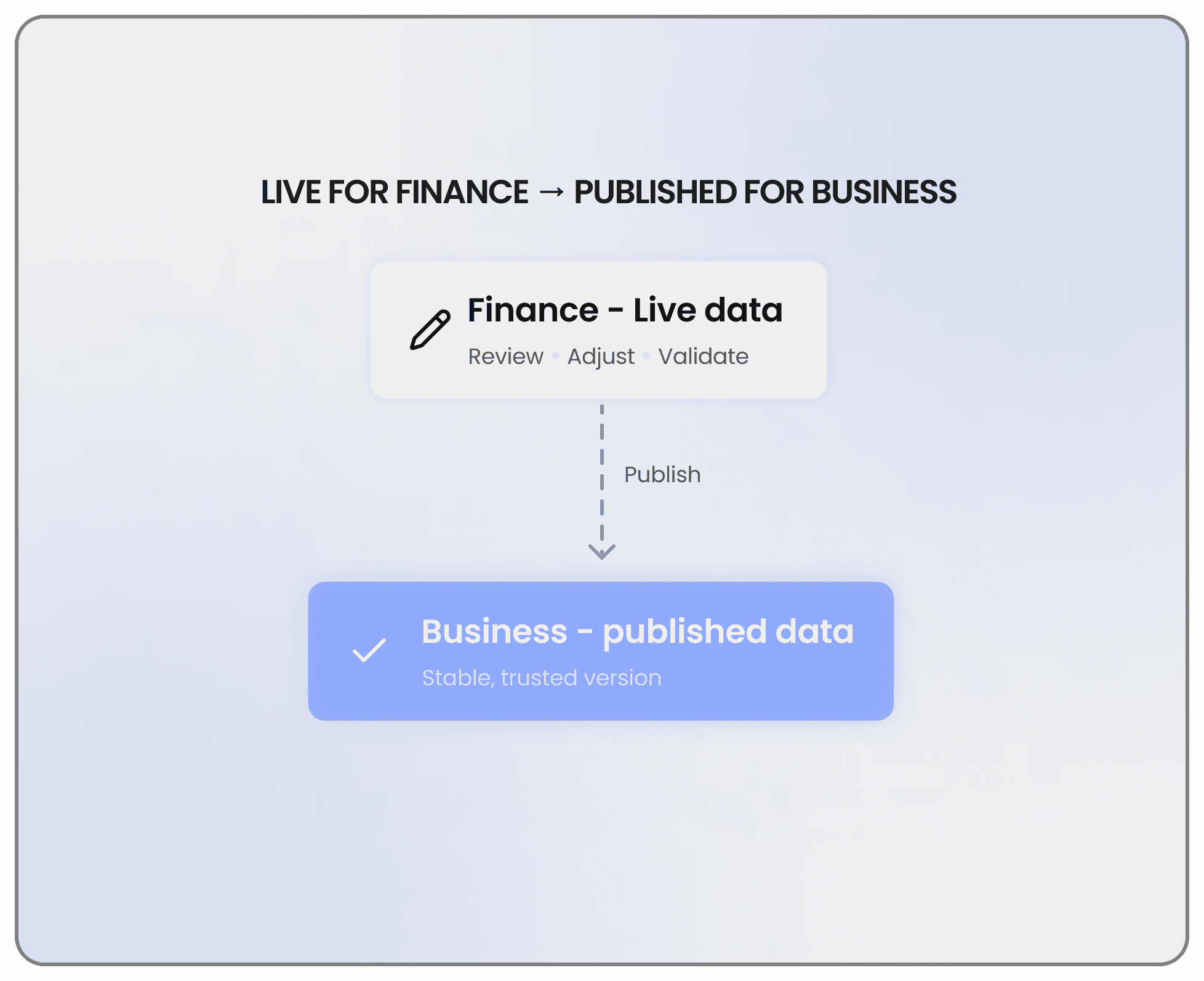
Finance users work with live data while reviewing, adjusting, and validating the numbers. Once reporting is ready, Finance publishes the validated version to executives, managers, investors, and operational teams.
Finance keeps preparing the numbers while the business gets a stable and trusted version of performance.
5.
Enable controlled self-service analysis
Executives, department leaders, and operational managers can filter, compare periods, expand levels, and investigate performance while staying within their approved scope of data.
Finance defines the trusted reporting model. Users explore safely inside it.

Finance controls what each audience sees
Boardroom is built around controlled access. This matters when financial data includes sensitive information such as salaries, detailed payroll, entity-level performance, margin details, investor reporting, or exceptional adjustments.
Finance defines who sees each board, which entities are available, which views are published, which metrics are visible, whether salary details are included, and how deep each user can explore.
From the same data layer, Finance can create different experiences:
Finance can analyze the numbers used for management reporting and decision-making, with the ability to understand what changed, where it changed, and why it changed.
Live data for Finance. Published data for the business.
Boardroom supports the way Finance teams work during and after closing.
Finance users access live data while they are reviewing, updating, and validating the numbers. Once the data is ready, Finance publishes it for broader consumption. Non-Finance users access the published version.
When the data is validated, Boardroom becomes the official space where decision-makers access the numbers Finance is ready to share.
Finance keeps the freedom to investigate movements and refine reporting, while the rest of the company works from a stable reporting view.
Built for multi-entity and multi-dimensional reporting
Boardroom is designed for companies with complex reporting structures.
It can support dashboards by:
A group CFO can monitor performance across entities. A country manager can focus on their perimeter. A department leader can follow their P&L. Finance can investigate the underlying accounting, payroll, budget, or adjustment detail.
Deeper exploration from the same dashboard
Boardroom lets users move from high-level performance to detailed explanations. A variance in EBITDA can be explored by entity, department, account, supplier, customer, employee, project, period, or transaction.
This depth applies to the full Finance-prepared dataset:
A revenue trend can be reviewed by client or business unit. A cost increase can be traced to a supplier, team, site, or exceptional item. Users explore the numbers Finance actually uses to run the business.

Standard reports and personal views
Boardroom supports both centralized reporting and individual exploration.
Finance configures group-level reports deployed to the relevant users. These define the official reporting experience: structure, filters, depth, columns, rows, timeframes, and access rights.
At the same time, users can create personal views for their own analysis when permitted — selecting dimensions, filters, rows, columns, and periods, while staying within the data scope and access rights defined by Finance.
Finance defines the trusted reporting framework. Users explore within that framework.
What finance teams use Boardroom for
Why Boardroom is different
1.
Built on Finance-governed numbers
Boardroom connects to the data foundation prepared in Builder. Every report is based on financial data that has been structured, mapped, adjusted, validated, and governed by Finance.
Users get a trusted reporting experience from the first screen to the deepest approved level of detail.
2.
Designed for financial structures
Boardroom understands the way Finance organizes performance: P&L levels, balance sheet categories, cash flow movements, actuals, budgets, year-to-date views, month-by-month analysis, entities, departments, salaries, and EBITDA adjustments.
Reports are built around financial meaning, management definitions, and decision-making needs.
3.
Controlled by audience, scope, and depth
Boardroom lets Finance control access by dashboard, data scope, salary visibility, entity, report structure, and drill-down depth — expanding financial visibility across the organization while preserving confidentiality and control.
4.
Configurable by Finance
Finance teams can create reports, adjust filters, define views, change columns, select levels, publish dashboards, and evolve reporting structures as reporting needs change.
5.
Connected to the full Nocloz platform
Boardroom sits between Builder and Dana AI. Builder creates the trusted foundation. Boardroom makes it visible. Dana AI makes it actionable.
The same financial data layer supports reporting, exploration, AI analysis, and decision-making.
Give every decision-maker the right financial view
Give every decision-maker the right financial view. Boardroom turns governed financial data into controlled, interactive, decision-ready reporting — while keeping Finance in control of the numbers, the definitions, the access rights, and the depth of exploration. Ready to make trusted financial performance visible across your company?


